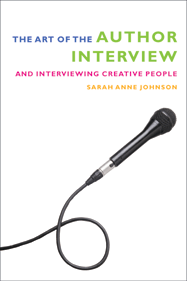
The Art of the Author Interview

    A practical guide to one of the most rewarding forms of literary journalism.

    Sarah Anne Johnson’s interviews with authors have been praised for her “thoughtful and knowledgeable questions” (Bloomsbury Review) that “provoke thoughtful responses from her subjects” (Publishers Weekly) and provide “an opportunity to participate in intimate and often illuminating dialogue” (Library Journal). Johnson also travels to MFA programs across the country, teaching workshops in how to conduct an author interview.

This book, based on that workshop, shows readers how to initiate, research, conduct, and publish interviews with authors and other creative people. Drawing on her own experience, Johnson not only covers the nuts and bolts of conducting the interviews, but she also offers an inspirational explanation of how the process can feed and enhance a writer’s own work and career.

More and more MFA programs now recognize the need to equip their students with the tools for building a “writing life”; in this book, Johnson provides a practical, inspiring guide to one of the most popular forms of literary journalism. In addition, students of journalism and broadcasting, and even fans, will find its down-to-earth approach to authors and writing liberating.

With examples, exercises, and step-by-step instructions, Johnson covers every step from preparation to publication. Widely praised for her own skillfully conducted interviews, Johnson is the perfect guide to this rewarding activity.



    TABLE OF CONTENTS
    Introduction: Building a Literary Life • Who Is This Book For?
    CHAPTER I: GETTING STARTED
    KNOW YOURSELF
    Where Do You Want to Publish Your Interviews? • How and to What Degree Are You Engaged in the Literary Arts? • Why Do You Want to Interview an Author? • What Has Kept You From Interviewing an Author before Now?
    CHOOSING THE AUTHOR
    Your First Interview • Use Your Connections • Use Your Credentials
    MAKING CONTACT WITH THE AUTHOR
    Through the Publicist or Agent • The Query Letter • Deconstructing The Query Letter • Developing a Query Letter Template
    CHAPTER 2: THE REAL WORK BEGINS
    CONDUCTING THE RESEARCH
    Researching the Author • Ongoing Research
    COMPOSING THE QUESTIONS
    The Role of the Interview Questions • Remember Your Audience • Types of Questions and Suggestions
    GETTING IT ALL ON PAPER
    Step One: Brainstorm • Step Two: Flesh Out Your Raw Material • Step Three: Put the Questions in Order • Step Four: Make Sure You've Covered Everything • Step Five: Get Feedback • Composing the Questions: Generative Exercise • Composing the Questions: Checklist • Interview Question Dos and Don'ts
    CHAPTER 3: LET'S LOOK AT THE PROS
    CHAPTER 4: TIME FOR THE INTERVIEW
    CONDUCTING THE INTERVIEW
    How to Present Yourself • In Person, Phone, Email • Equipment and Other Technical Issues • Your Role as Interviewer • Using Your Road Map
    TRANSCRIBING THE INTERVIEW
    CHAPTER 5: REFINING THE INTERVIEW
    EDITING THE INTERVIEW
    Staying True to the Author's Voice • Use of Slang or Curse Words • Including the Author in Revision • Working with the Editor
    THE AUTHOR'S BIOGRAPHICAL NOTE
    The Straightforward Author's Biographical Note • The Narrative Author's Biographical Note • The Narrative First-Person Bio • Deciding for Yourself
    THE INTERVIEWER'S BIOGRAPHICAL NOTE
    MULTITASKING: HOW MANY INTERVIEWS IN THE FIRE AT ONCE?
    CHAPTER 6: PUBLISHING THE INTERVIEW
    FINDING THE RIGHT PUBLICATION
    Create Your Submission Hit List • Where to Find Publications • To Multiply Submit or Not to Multiply Submit • Offer an Exclusive Look • Why Query First? • The Writer's Guidelines • Getting the Query Right • Deconstructing the Query Letter • Query Letter Dos and Don'ts • The Fine Art of Patience • The Inevitable Rejections • Working with the Editor
    COPYRIGHT ISSUES
    CHAPTER 7: KEEP YOU RINTERVIEW WORKING
    FOLLOW-UP
    FINDING NEW USES FOR YOUR INTERVIEW
    Reprint Rights • The Art of the Author Profile
    CHAPTER 8: INTERVIEWING OTHER CREATIVE PEOPLE
    Putting These Principles to Use with Other Artists • Example: Inside the Actor's Studio • Example: Writer A. M. Homes Interviews Painter Eric Fischl • Example: Interview with Screenwriter Max Adams
    CHAPTER 9: THE AUTHOR INTERVIEW IN OTHER MEDIA
    TELEVISION BROADCASTING
    Format • Target Audience • Commercial, Public, and Cable Television • Television is Visual--How Will You Look? • Improving Your Interview Skills by Watching TV Interviews
    RADIO BROADCASTING
    CHAPTER 10: THE ART OF THE AUTHOR INTERVIEW IN THE WRITING PROGRAM
    THE M. F. A. PROGRAM
    Program Models • Program Ideas
    THE UNDERGRADUATE WRITING PROGRAM
    Beginner Program Ideas
    CHAPTER 11: FINAL THOUGHTS AND INTERVIEW TIPS
    REJECTION AS INFORMATION
    COMMON PROBLEMS
    Lack of Preparation • Disorganization • Inarticulate Questions • Inappropriate Questions • Interview Is Too Faithful to Spoken Event • Too Much Analysis • Self-Promotion by Interviewer • Too Muc Commitment to the List of Questions
    WHAT TO DO WHEN YOU'RE OUT OF TIME
    APPENDIX: THE HISTORY OF THE AUTHOR INTERVIEW
    George Plimpton and the Paris Review • The Interview as an Evolving Form • The Future is Now

    For ordering information visit University Press of New England or call 1-800-421-1561

© 2005 Sarah Anne Johnson